Last updated July 20, 2026
The operating systemfor complex wealth.
Velira turns a founder's whole financial life into one honest number and the exact move their plan calls for that day — grounded in survival math, read-only by design. Anyone can track money; Velira tells you what to do with it.
Live software, not a deck slide.
Velira already spans the founder's full balance sheet across 20+ capabilities — including Ask Velira, a conversational layer (text or voice) grounded in the member's live numbers that explains the why and tells you no. Real screens, not mockups:
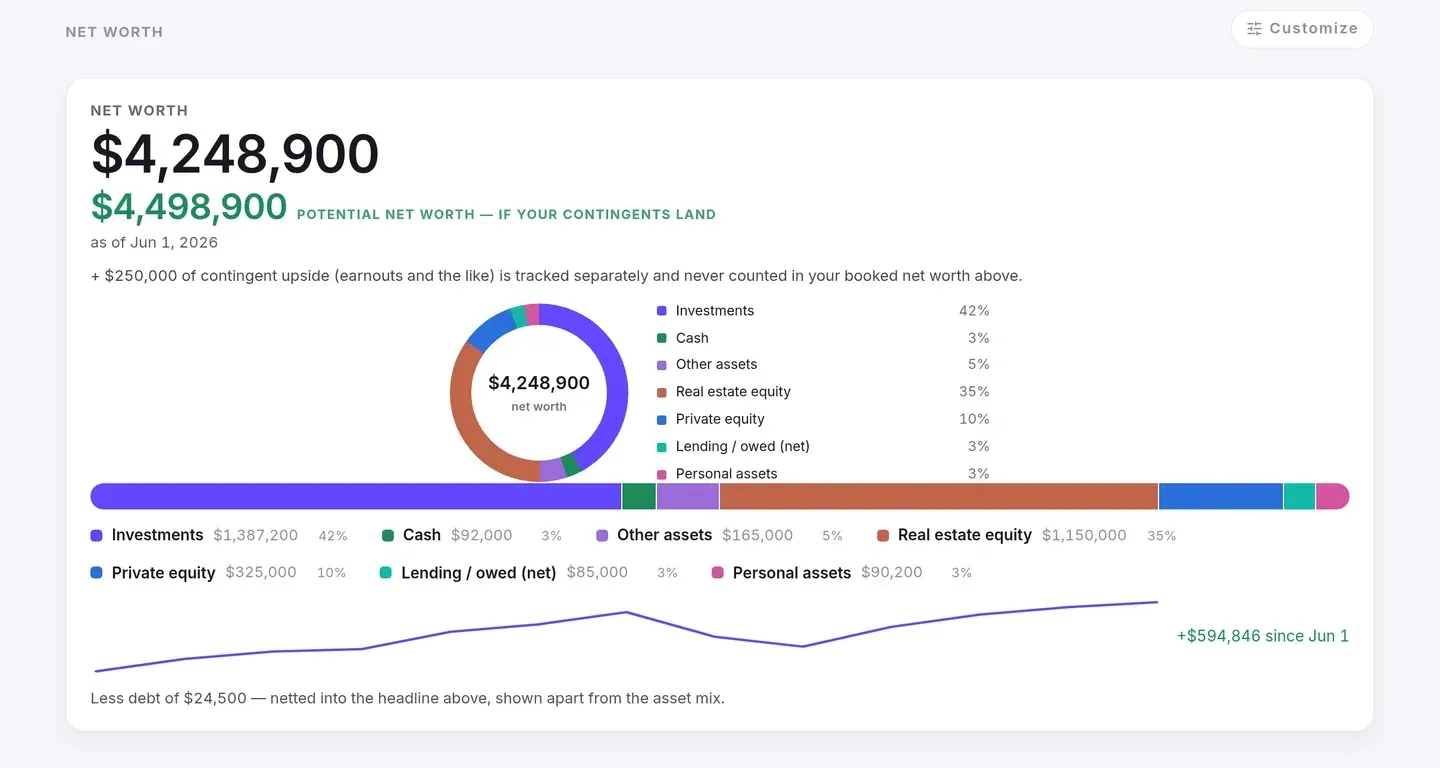
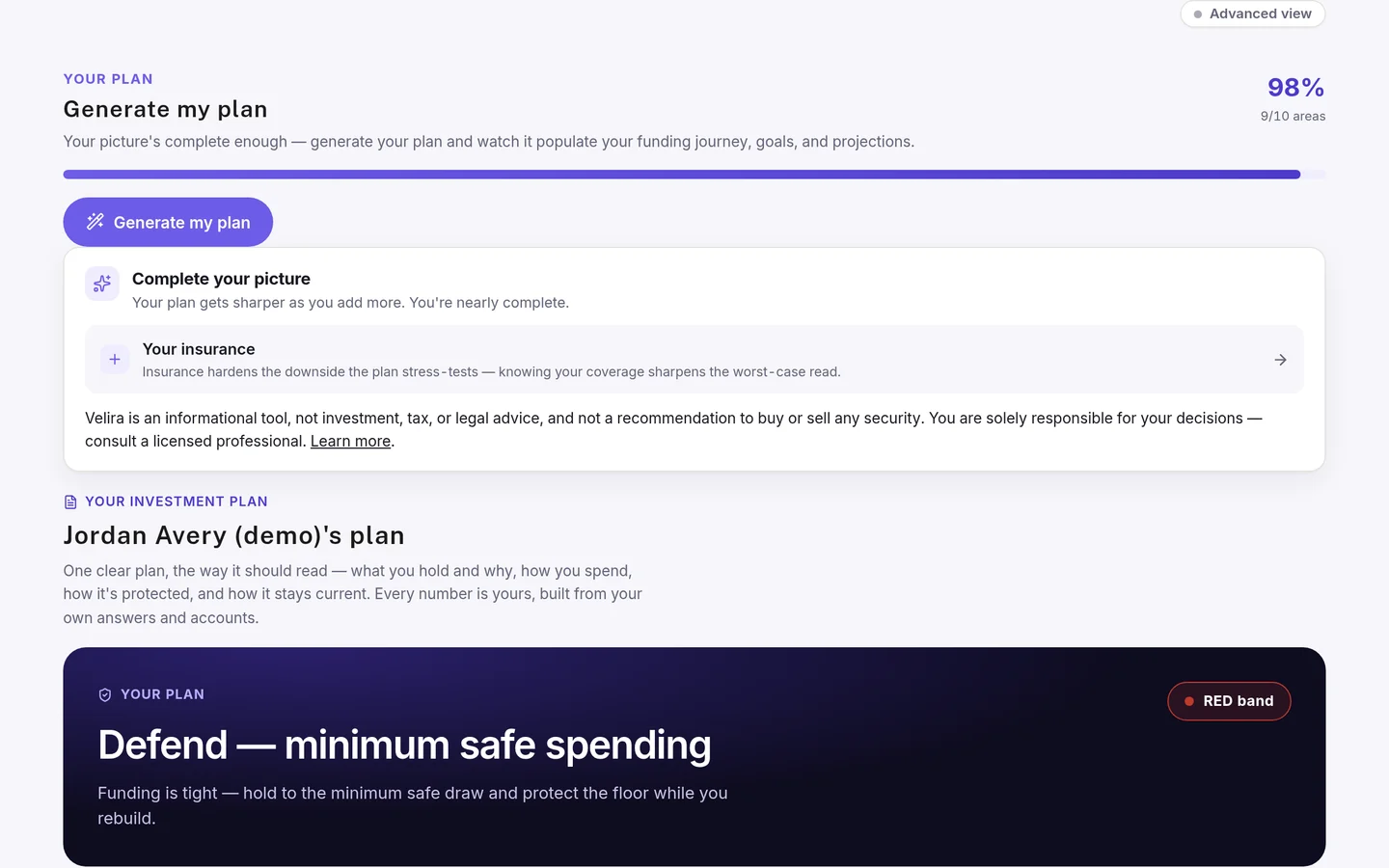
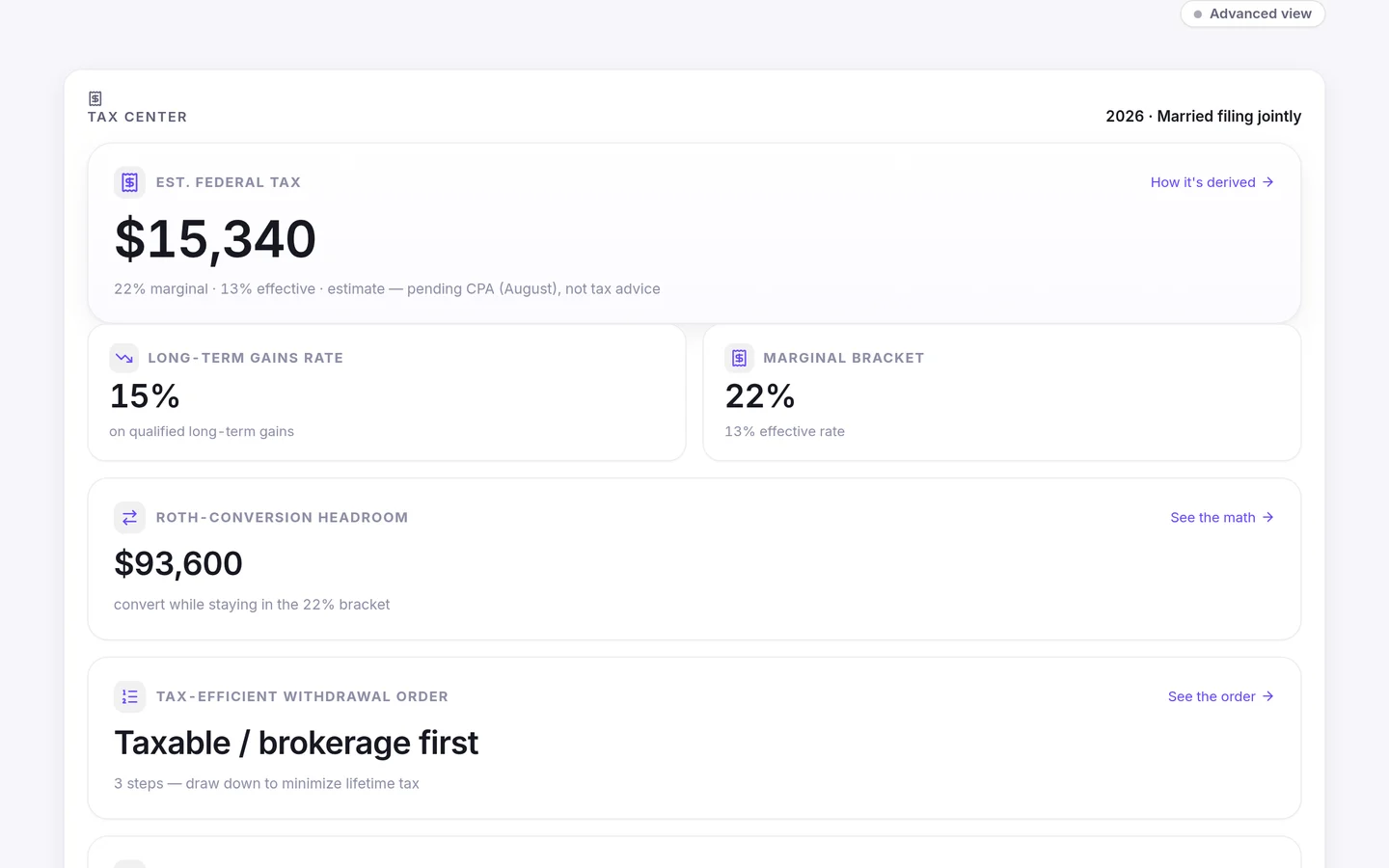
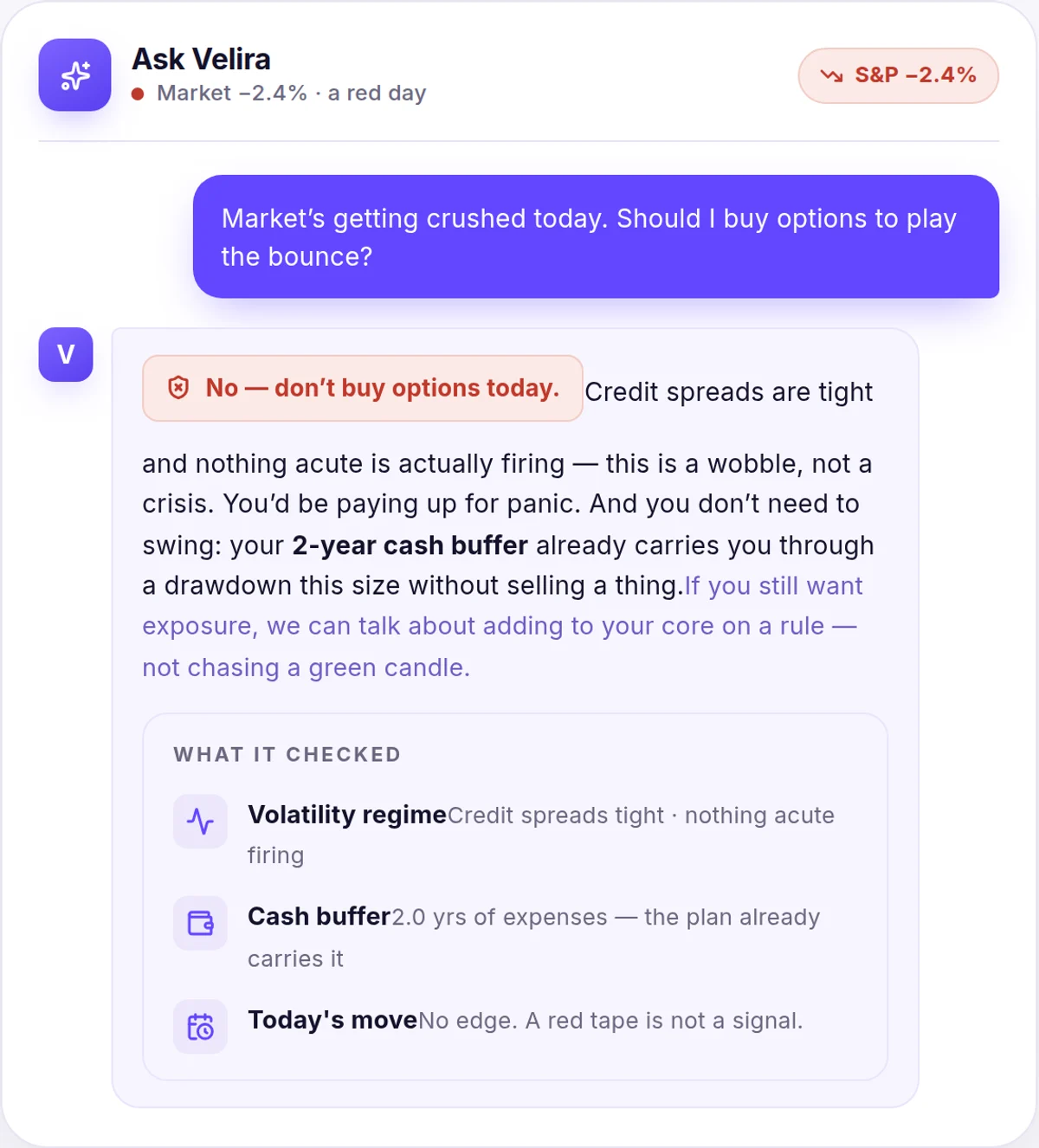
One founder runs the whole business from one console.
Velira isn't only the member app — the same codebase ships an operator backend that runs the company. It's how a small team operates a regulated-adjacent fintech without a back office, and it's the same architecture that scales:
- Real-time revenue: members by tier, recurring revenue, churn and cohort retention
- Growth engine: acquisition funnel, attribution, campaigns, CAC/LTV — and ad + AI cost
- Member operations: full directory, account actions, support, sync-error triage
- Compliance built in: one-click DSAR export/delete with signed certificates + an immutable audit log
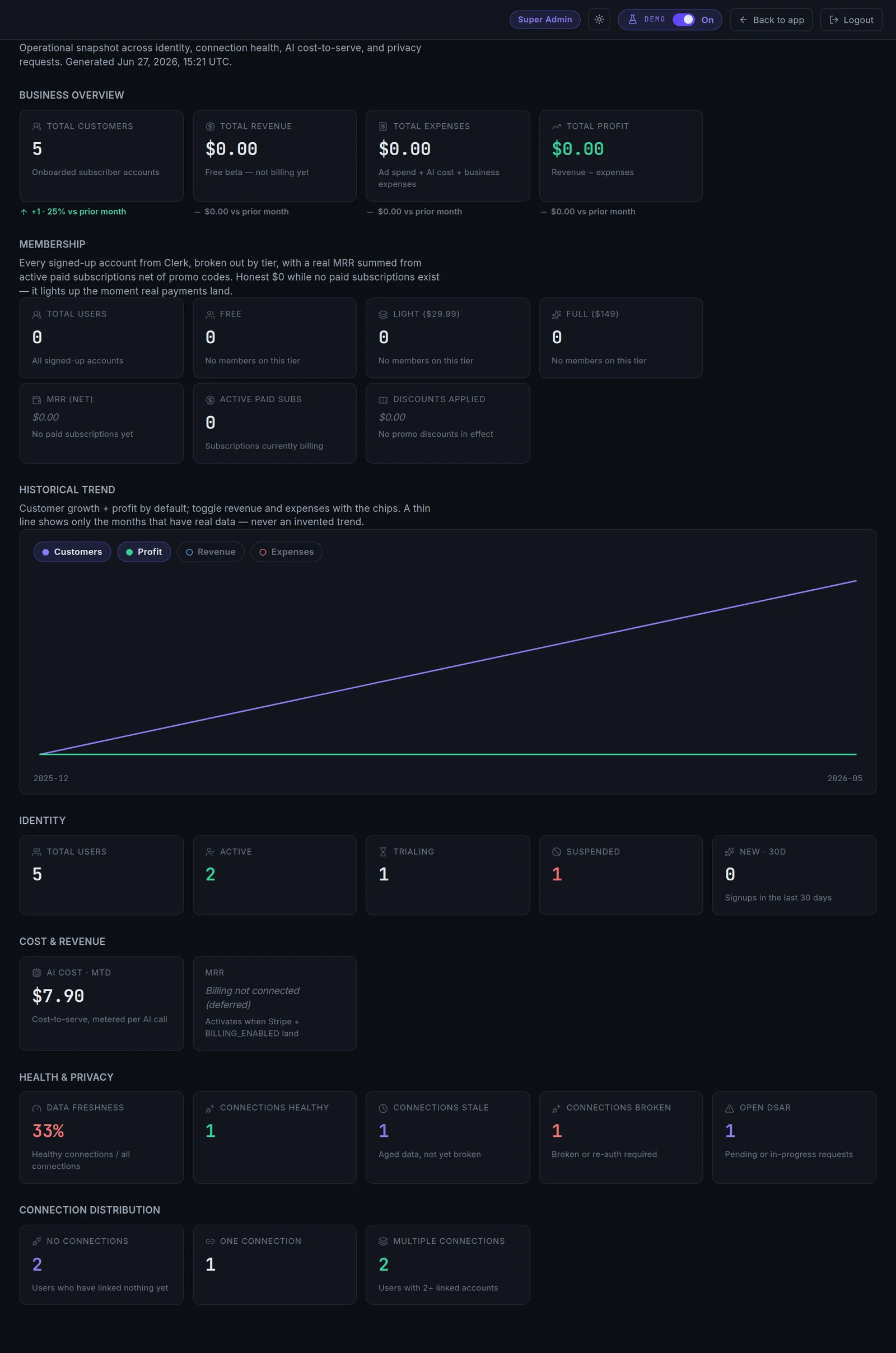
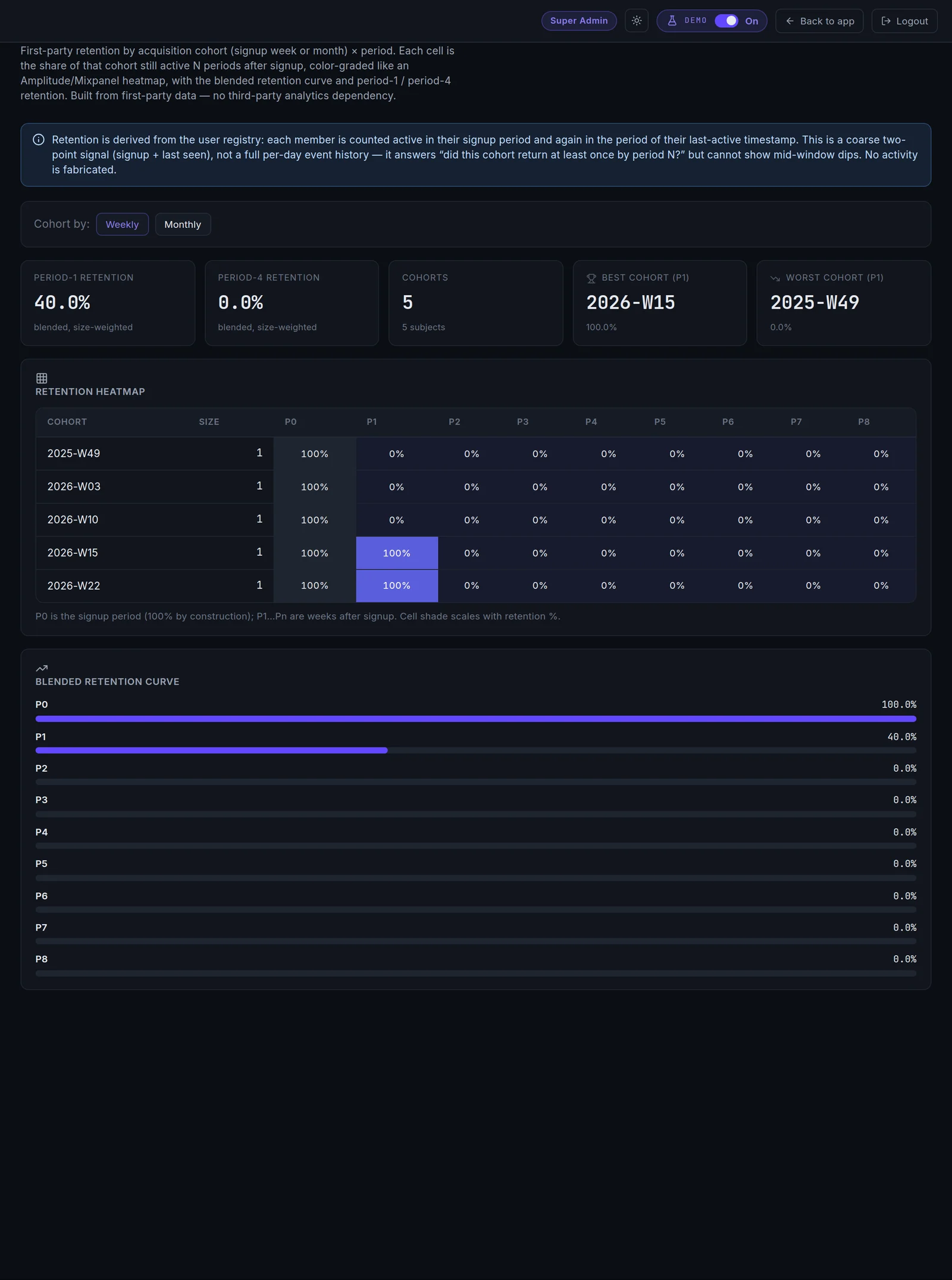
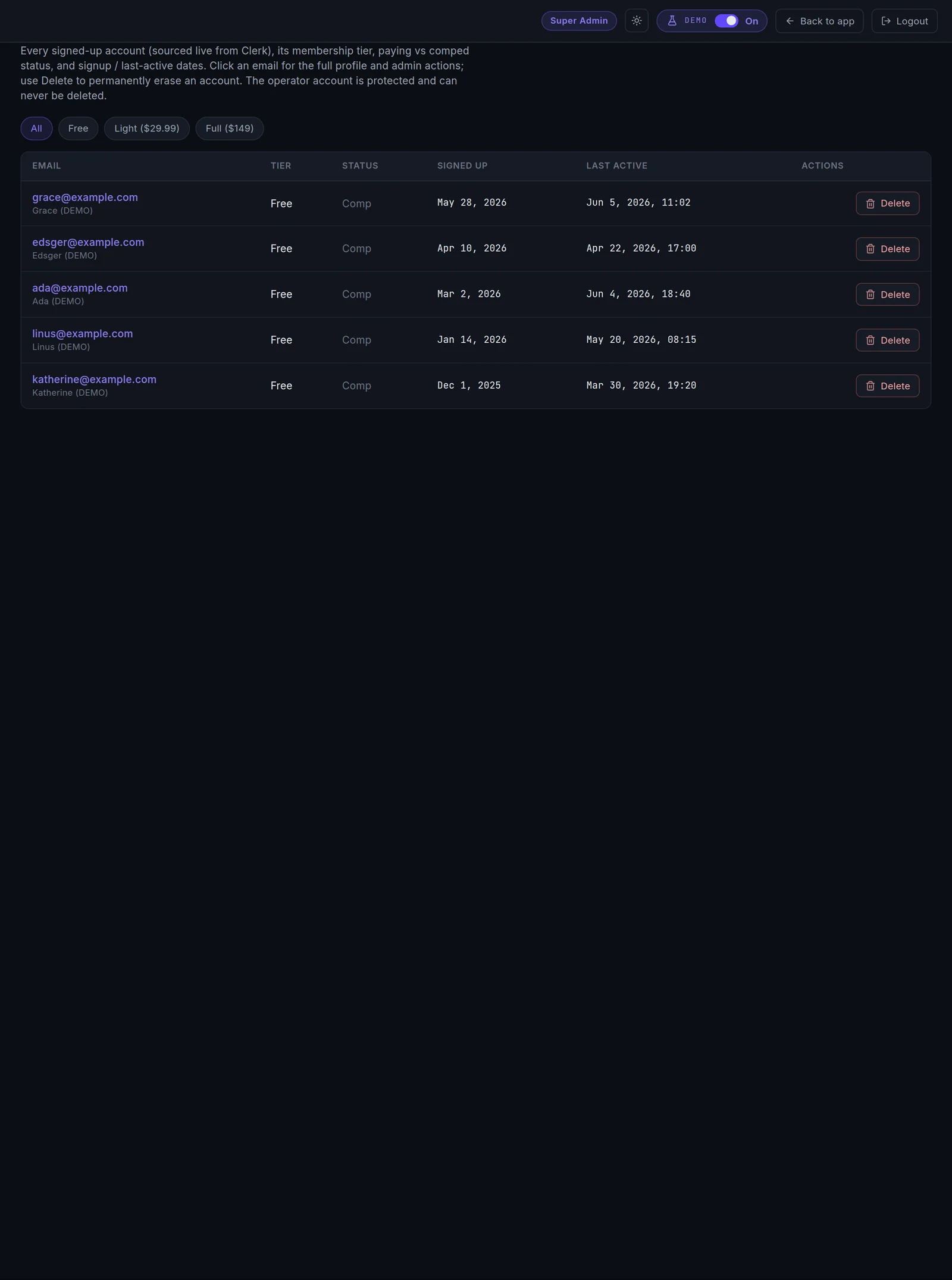
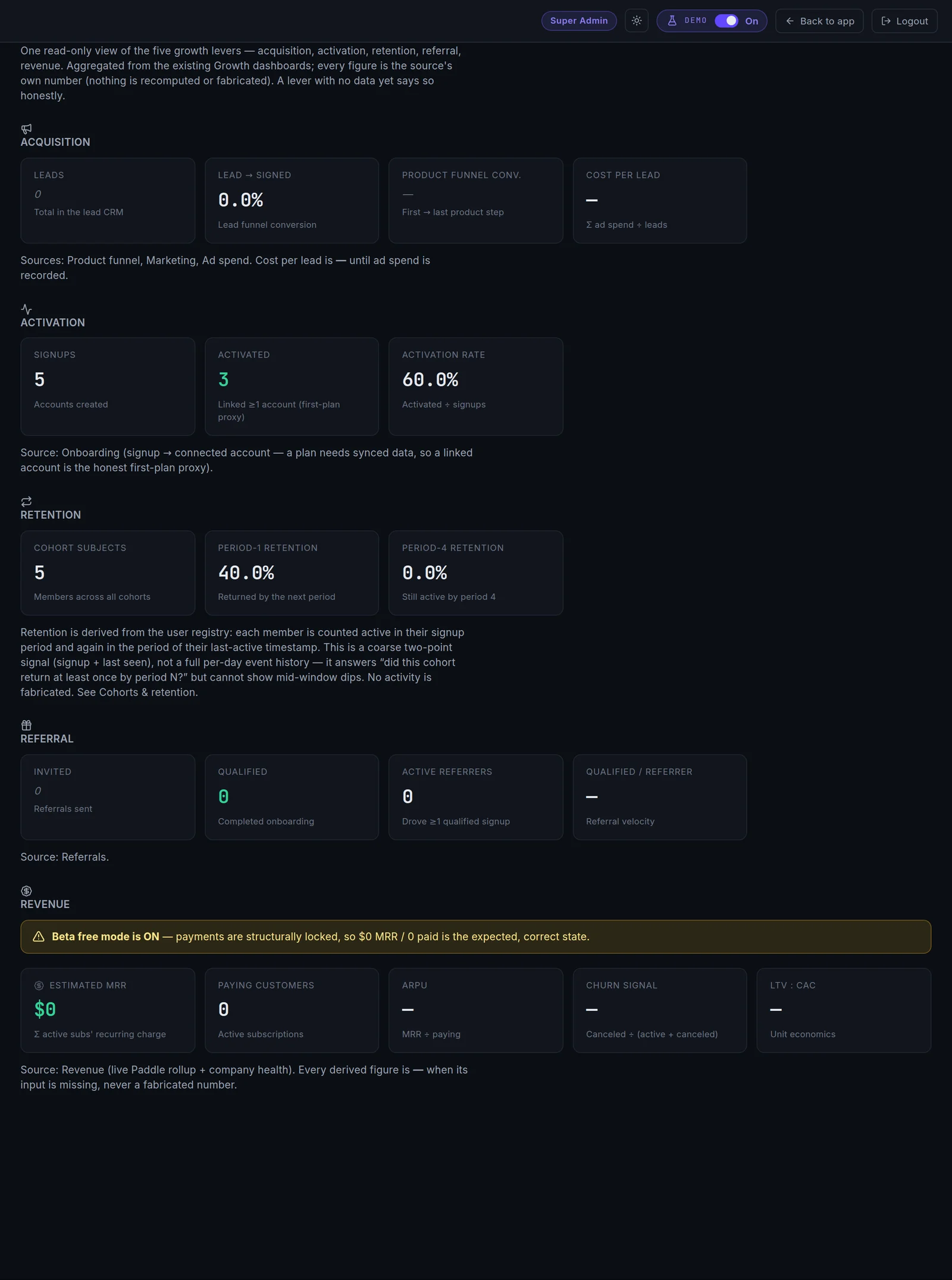
Admin screens shown in the demo view with synthetic fixtures — never real member or operator data.
Complex wealth has no home.
A fast-growing class of people — founders and operators mid- or post-liquidity-event — hold earnouts, escrows, private stakes, notes, real estate, and business equity alongside ordinary accounts. The tools they reach for are built around a bank and a brokerage and go blank on exactly the assets that matter most. The result: real money, no honest picture, and no daily plan for it.
$100/yr trackers show charts. $20k/yr advisors take weeks. Neither tells you the move today.
The window is open.
A liquidity-event wave
Company sales, secondaries, IPOs, and large vesting events are minting complex-wealth individuals faster than the incumbents can serve them.
Grounded AI is finally trustworthy
Explainable, decline-capable AI makes real decision-support possible — but only on a true system of record with an audit trail, not a generic chat. That is Velira's wedge.
Incumbents are structurally stuck
Trackers and advisor dashboards are anchored to a bank and brokerage. Serving private and contingent wealth means rebuilding their core. They won't pivot.
Our thesis: an 18–24 month window
Incumbents have the users but not the architecture; AI-native newcomers have speed but not the compliance footing or the product depth. Velira holds both today — and that advantage is perishable. This raise is sized to press the window while it exists.
An architecture incumbents can't copy.
Two ledgers, never blended
Confirmed net worth (the honest floor) vs. Structural (graded contingents). You plan against Confirmed; upside can never inflate the risk budget.
Built for complex wealth
Earnouts, private stakes, notes, real estate, crypto — exactly where Mint, Monarch, and Empower go blank.
Auditable “Why” trace
Every recommendation shows its inputs, engine version, and the rules that fired. Append-only — a moat a chat can't match.
Read-only, never-executes
Velira tells you the move; it can never touch a dollar. A structural trust guarantee.
It can never touch a dollar.
A large, underserved wedge.
Derived from stated assumptions (household counts × ARPU), not researched market data — to be validated.
The market — and how it actually buys.
The size (HNW households × ARPU) is only half the answer. The check-writing question is the SHAPE: who buys, on what trigger, and how Velira reaches them.
A barbell, not a blob
Mass-affluent DIYers who've outgrown a budgeting app but can't justify a $20k advisor — and HNW post-liquidity founders who need a plan the week the wire lands.
How they buy
Mass-affluent buy self-serve, tools-first, on a specific pain (an RSU tax bill, a concentration call). HNW buy on a triggering event — a sale, a secondary, an IPO — and on trust.
How Velira reaches them
Tools-led funnel (free calculators that rank in search and capture the exact pain), liquidity-event detection (public M&A / IPO filings → founders the week money lands), and an owned AI concierge — all already in the product.
Why this must be vertical-built.
A general chatbot or a robo-advisor is trained on the median balance sheet — a paycheck, a brokerage, a 401(k). It goes blank exactly where complex wealth lives. Velira's wedge is that complex-wealth workflow, an honest-floor survival engine that plans against only what's confirmed, and “the move today.” That is not a prompt you bolt onto a general tool — it is the product.
General tools are trained on the median balance sheet — a paycheck, a brokerage, a 401(k). They go blank on exactly the assets that define complex wealth. Velira is built around them.
“They'll just use ChatGPT.”
It can't be your system of record
A general chat has no memory of your balance sheet — every session starts from zero. Velira holds the live, connected picture.
It can't show an auditable Why-trace
Velira's recommendations carry their inputs, engine version, and the rules that fired — append-only. A chat answer can't be examined.
It isn't read-only by design
Velira structurally can never touch a dollar. A general agent with account access is a different, riskier animal.
It doesn't tell you no
Velira declines on red days. A general model optimizes for a helpful-sounding answer, not survival math.
A general tool is a complement at the edges — it can't cannibalize a system of record it structurally can't hold.
The moat is embeddedness.
- Seven apps, each seeing a sliver
- A spreadsheet that's already stale
- An advisor's inbox
- No single source of truth
- The whole balance sheet in one place
- The honest number + the move today
- An append-only audit trail
- The system of record you return to
Once Velira is the system of record — connected accounts, graded contingents, the Why-trace history — ripping it out means going back to blindness. The switching cost is the member's own financial memory. That is the data play, on top of the auditable Why, the two-ledger architecture, and read-only-by-design.
Premium price, software margins.
Four annual tiers, one product. Velira OS at $2,000/yr (annual only) plus a required one-time $1,000 white-glove onboarding — $3,000 in year one, then $2,000/yr. The human-advisor tiers layer a named professional on top. Annual billing only — no free tier, no trial, no monthly plans, and no AUM fee at any tier. Stripe is our payment processor; Velira is the seller of record.
Velira OS — $2,000/yr
Pure software — the full Velira app, instant self-serve; plus a required one-time $1,000 white-glove onboarding ($3,000 in year one).
Velira Wealth — $3,500/yr
Everything in Velira OS plus a named fiduciary CFP; white-glove onboarding included.
Velira Tax — $7,000/yr
Everything in Velira Wealth plus a named CPA — year-round personal tax planning + 1040 prep & filing (personal only); white-glove onboarding included.
Velira Estate — $9,500/yr
Everything in Velira Tax plus a licensed estate attorney who reviews and finalizes your documents; white-glove onboarding included.
LTV vs CAC (per member)
Assumes ~88% margin, $500 blended CAC, ~3-yr retained life on the $2,000/yr OS tier — illustrative and conservative (higher tiers only raise ARPU).
Velira is decision-support software today. The human-advisor tiers (a named fiduciary CFP, CPA, or estate attorney) are consultation-led and launch behind SEC investment-adviser registration, which Velira is pursuing with counsel — registration is not yet effective.
Illustrative only — assumptions stated. These numbers model scenarios, not commitments. Velira is an early-stage, pre-revenue (private-beta) company; any economics shown are estimates pending a verified financial model.
A live product with momentum.
- Live product in private beta — 20+ member capabilities already shipped
- Proven on the founder's own eight-figure exit before opening up
- Ask Velira: a conversational layer, by text or voice, grounded in the member's live numbers — it explains the why and tells you no
- Acquisition machinery built-in: tools-led calculators, an AI concierge, and liquidity-event lead detection
- Four-tier annual pricing published, with live self-serve checkout infrastructure (Stripe as our payment processor) gated behind counsel sign-off
Early-stage — quantitative member/revenue metrics are added here as billing data accrues; never fabricated.
Distribution built into the product.
Tools-led top of funnel
Free, SEO-friendly calculators (RSU/earnout tax, concentration, safe-withdrawal, estate) capture email and nurture to paid — low blended CAC.
Liquidity-event targeting
Automated detection of founders from public M&A / IPO filings — reaching people exactly when complex wealth lands.
Owned funnel + AI concierge
A grounded sales concierge, an attributed lead CRM, and referral/commission tracking — all already in the product.
Only Velira does all four.
* Velira OS: $2,000/yr (annual only) plus a required one-time $1,000 white-glove onboarding — $3,000 in year one. Human-advisor tiers from $3,500/yr.
The shape of the model.
Illustrative ARR ramp (members × $2,000)
Members: Y1 250 · Y2 1,500 · Y3 6,000 · Y4 12,000 · Y5 18,000. Scenario inputs, not a forecast.
Three things move the outcome
The ramp above is the base scenario, not a forecast. Here is the honest band around it:
What changes which case you get: SEC registration timing (it gates the advisor-tier launch), realized CAC on the human tiers (unproven at scale — the model's $500 is a target), and churn on OS-only members. The paid-spend guardrail cron checks realized CAC against target daily once spend begins.
Forward-looking statements. Any figures describing the future — pricing, margins, growth, or outcomes — are illustrative estimates based on stated assumptions, not forecasts, guarantees, or promises of results. Actual results may differ materially. Nothing here should be relied upon as a prediction of performance.
$500M is a ~10,000–14,000-member outcome — not a “millions of users” outcome.
Velira's high blended ARPU means the path to a ~$500M valuation runs through roughly ten-to-fourteen-thousand paying members, not millions of free users. That is the whole shape of this business.
$500M ÷ ~12,000 members ≈ ~$42K per member ≈ ~12× a $3,500 ARPU — coherent, because it is simply the multiple × ARPU.
Seed → Series A → B → C → ~$500M
- Seed~150–285Paying members~$525K–$998KARR (members × ARPU)~$5.3M–$15.0MValuation (10×–15×)
Flip to paid; first real CAC/LTV; compliance footing; de-risk the single-founder dependency. (early rungs are priced on potential/round size more than an ARR multiple)
- Series A~600–1,000Paying members~$2.1M–$3.5MARR (members × ARPU)~$21.0M–$52.5MValuation (10×–15×)
Repeatable tools-led acquisition; the human-advisor tiers live behind SEC registration; retention proven. (early rungs are priced on potential/round size more than an ARR multiple)
- Series B~1,000–3,500Paying members~$3.5M–$12.3MARR (members × ARPU)~$35.0M–$183.8MValuation (10×–15×)
System-of-record embeddedness; the advisor bench scales with the Wealth/Tax/Estate tiers.
- Series C~5,000–10,000Paying members~$17.5M–$35.0MARR (members × ARPU)~$175.0M–$525.0MValuation (10×–15×)
Category leadership in complex wealth; the data play and agent hooks compound.
- ~$500M (pre-IPO / exit)~$500M target~10,000–14,000Paying members~$35.0M–$49.0MARR (members × ARPU)~$350.0M–$735.0MValuation (10×–15×)
A ~$500M outcome on ~10,000–14,000 paying members — a system of record an acquirer pays up for.
The ARPU-leverage member ladder
$500M ÷ ~12,000 members ≈ ~$42K per member ≈ ~12× a $3,500 ARPU — coherent, because it is simply the multiple × ARPU.
Valuation vs. members — conservative (10×) to optimistic (15×)
Why a 10×–15× ARR band
Public SaaS trades ~3.4×–8.5× revenue; top private companies (Bessemer's Cloud 100) average ~20× ARR (AI ~24×). We model a deliberately conservative growth band of 10×–15× ARR — between the public floor and the private top — and always show both ends so the valuation is a band, not a point.
- ~3.4×–8.5× — Broad public SaaS EV/Revenue2025–2026 (Aventis / SaaS Capital / Meritech)
- ~20× ARR (AI ~24×) — Top-private “Cloud 100” averageBessemer 2025
Neobank per-registered-user figures ($255–$1,250) are NOT comparable — those users are mostly free; Velira counts only paying members.
Illustrative and forward-looking — not a forecast, a guarantee, or an offer to sell securities. Velira figures are management estimates built from a stated blended ARPU ($3,500) × a stated 10×–15× ARR multiple band; the company is pre-revenue (private beta) with no member/revenue traction yet. Every competitor/comp figure is a real, sourced datapoint (source + date on each).
Claude is the engineering org.
The comps raised nine figures to reach their outcomes — mostly to fund large engineering teams. Because Claude builds the product, Velira's engineering burn is near-zero. Capital goes where it actually de-risks a regulated-adjacent fintech: compliance, legal & security (RIA/SEC registration, SOC 2, audits), the human-advisor bench (the CFP/CPA/Estate headcount that scales with the Wealth/Tax/Estate tiers), and go-to-market.
Capital raised to reach the outcome — them vs. a Claude-built Velira
Cumulative-funding figures are reported aggregates (company press / Crunchbase); each outcome carries its own source.
What a tiny, AI-native team can now carry — the shape of the thesis (reported figures / estimates, labeled):
How an acquirer values the system of record.
The embeddedness moat has a price. When incumbents buy aggregated-finance companies, they pay up for the complete, funded relationship — the data, not the page views.
Data-play acquisitions & the public comp
Acquirers pay up for the system-of-record data and the funded relationship — not for page views. Velira is built to BE that system of record from day one. (Bar length uses a √ scale so the smaller deals stay visible next to the $8.1B one.)
Every competitor figure is real and cited.
Nothing on this page invents a competitor number. Each comp below links to its primary source with an as-of date; low-confidence items are flagged. Velira's own figures are illustrative projections built from a stated $3,500 blended ARPU and a stated 10×–15× multiple — never a forecast.
Built by the customer.
I sold my company and suddenly had earnouts, escrows, private stakes, land, notes — and seven apps that each saw a sliver. So I built the thing I needed: one honest number, a real plan, and a coach that tells me no on red days. Velira ran my own eight-figure exit before it ran anyone else's.
A technical operator who lived the problem, built the product, and ran it on his own post-exit finances before opening it up — the reason Velira obsesses over the assets and decisions other tools ignore.
Built by the customer
A technical operator who lived the problem and ran Velira on his own eight-figure exit before opening it up.
GTM sells the outcome
Not “a dashboard” — the honest number and the move today, priced against the $20k advisor it partially replaces.
Speed is the edge
Velira is Claude-built, so dev cycles run in weeks, not quarters — which is also the capital-efficiency thesis.
Building the team
The seed funds the first hires that retire the single-founder dependency:
Compliance / RIA lead
Owns the registration path and the compliance program counsel signs off on — the gate in front of the advisor tiers.
Growth lead
Runs the tools-led acquisition engine and liquidity-event outreach — the 40% GTM allocation, executed.
Advisor-bench lead
Contracts and scales the fiduciary CFP / CPA / estate capacity behind the Wealth, Tax, and Estate tiers.
$1.0M to reach the next inflection.
In ~12–18 months:
- Billing + entitlement infrastructure built and ready to switch on — flip to paid, then add real CAC/LTV
- Depth features that visibly justify the price
- Compliance, legal & data-security footing for public launch
- First advisory/growth hires to de-risk the single-founder dependency
- Metrics that position a strong seed / Series A
Use of funds
- 40%Growth & member acquisition
- 20%Human advisory bench (CFP · CPA · estate)
- 15%AI-native product build — compute, models & data
- 15%Compliance, legal & security
- 10%Founder ops & contingency
Amount, instrument, valuation, and allocation are drafted from the model — the founder finalizes them with counsel. Any future securities offering, if one is made, may be limited to accredited and/or institutional investors and would be made only through definitive offering documents and in compliance with applicable securities laws, including any applicable exemption from registration. Self-identifying your investor category on this page is informational and non-binding; it is not verified here and does not qualify you for, or constitute participation in, any offering. No funds are being solicited or accepted through this page.
What we're watching
Every early company carries risk. Ours, plainly, with the mitigation for each:
SEC registration timeline
The advisor tiers launch behind counsel and registration — a slow path delays the highest-ARPU revenue. Mitigation: the IARD/registration track starts first (it's the long pole), and Velira OS sells software-only in the meantime.
Advisor-tier CAC
Unproven at scale; the model's $500 blended CAC is a target, not a result. Mitigation: a spend-guardrail circuit breaker checks realized CAC against target daily and pages the operator before budget burns.
Single-founder dependency
Real today. Mitigation: the first hires this round funds (compliance, growth, advisor bench) plus an operator backend built so the business can be run by more than one person.
AI model reliability
The grounded, audited architecture reduces the error surface — it does not eliminate it. Mitigation: every recommendation is propose-only with an auditable Why trace, and the member executes every trade themselves.
Where this goes: agent-to-agent.
The endgame is your Velira agent talking to the other agents in your financial life — your advisor's, your bank's, your CPA's — grounded in a balance sheet only Velira holds whole. Velira already ships the companion write-flow and the agent hooks; the system of record is the asset that makes A2A defensible.
You hold the whole picture
Every other agent has to ask the one that holds the honest, complete, auditable balance sheet — that's Velira.
Grounded, not guessing
A2A only works when one side is a true system of record with an audit trail. A general agent negotiating on a scraped, partial picture is a liability.
Already wired
The companion write-flow and agent hooks exist in the product today — the roadmap is depth, not a rebuild.
The A2A future is the roadmap/vision — companion write-flow and agent hooks are live; the agent-to-agent network is not yet shipped.
Become the system of record for complex wealth.
Start with founders post-liquidity-event; expand to every high-income household the incumbents can't serve. The honest number, the daily move, and the audit trail — for everyone whose financial life outgrew a budgeting app.
Request the deck & a conversation.
Investor, strategic partner, or both — tell us a little about you and Andy will be in touch personally with materials. The start of a conversation, not a commitment.